


高功率重載車輛用燃料電池的質子化膦酸電極
采用聚乙烯為主鏈,側鏈為嵌段型聚四氟苯乙烯基膦酸和聚五氟苯乙烯,全氟磺酸聚合物也參與到電極中(網上僅有預印本全文,無正式版本全文,不確定電極聚合物之間的關系),其中全氟磺酸的質子被轉移到膦酸,以增強燃料電池電極的無水質子傳導能力。
常規磷酸摻雜PBI等物質因為水的生成造成磷酸流失,耐久性不良。
膦酸十年前的質子電導還很差,未引人關注。該文章有了突破,但冷啟動到高溫段有高內阻過程,膦酸的存在會讓不同狀態的水影響冷啟動的處理,催化劑載量過高。
Protonated phosphonic acid electrodes for high power heavy-duty vehicle fuel cells
Abstract
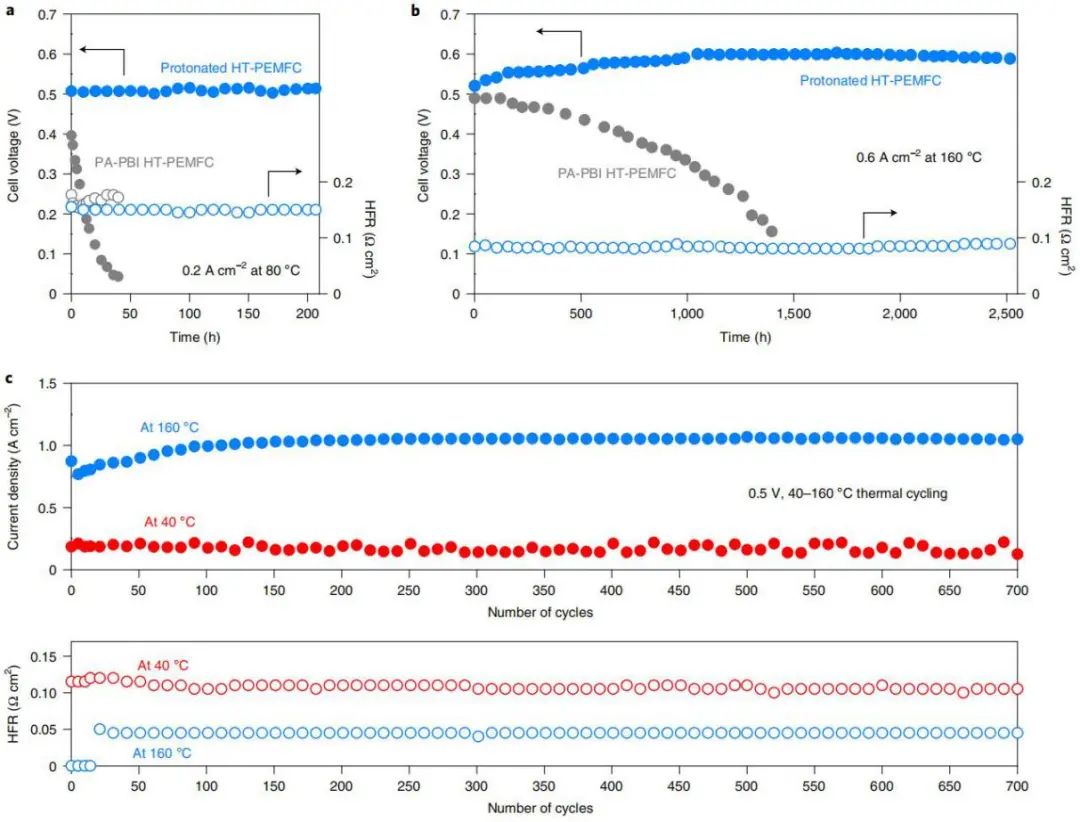
State-of-the-art automotive fuel cells that operate at about 80?°C require large radiators and air intakes to avoid overheating. High-temperature fuel cells that operate above 100?°C under anhydrous conditions provide an ideal solution for heat rejection in heavy-duty vehicle applications. Here we report protonated phosphonic acid electrodes that remarkably improve the performance of high-temperature polymer electrolyte membrane fuel cells. The protonated phosphonic acids comprise tetrafluorostyrene-phosphonic acid and perfluorosulfonic acid polymers, where a perfluorosulfonic acid proton is transferred to the phosphonic acid to enhance the anhydrous proton conduction of fuel cell electrodes. By using this material in fuel cell electrodes, we obtained a fuel cell exhibiting a rated power density of 780?mW?cm–2 at 160?°C, with minimal degradation during 2,500?h of operation and 700 thermal cycles from 40 to 160?°C under load.
Lim, K.H., Lee, A.S., Atanasov, V. et al. Protonated phosphonic acid electrodes for high power heavy-duty vehicle fuel cells. Nat Energy (2022). https://doi.org/10.1038/s41560-021-00971-x
關鍵性數據
Nafion對水很敏感
H2/air fuel cell performance of Nafion-based LT-PEMFCs at 100?°C as a function of RH.

120度時三種競爭者
Comparison of H2/air fuel cell performance of different MEAs at 120?°C.

左下角新聚合物

模型化合物是

圖e在無水的200度條件下獲得高效率的高性能,達到1.64A/cm2@0.64V
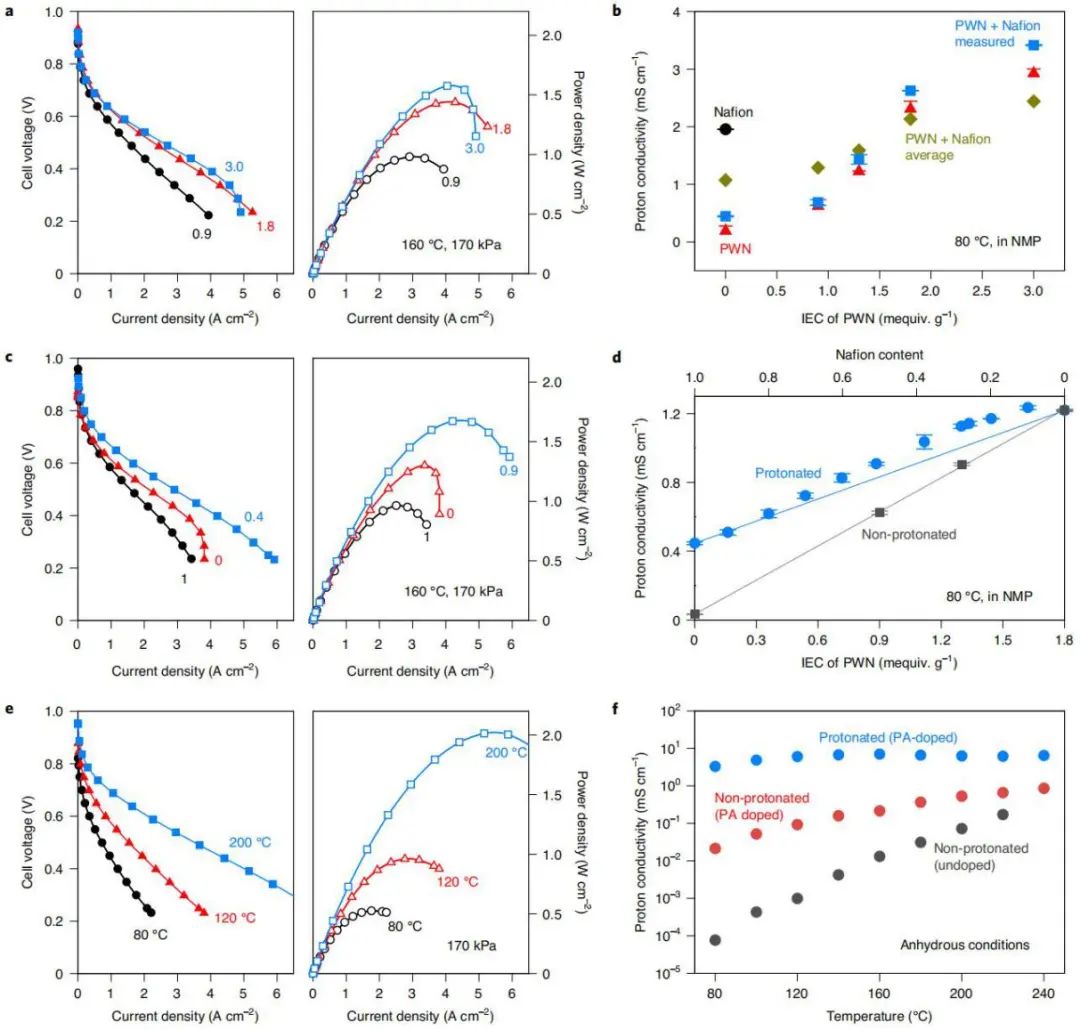
對不同技術路線的狀態做了對標。
OrganizationRated power density (mW/cm2)operating temperature (C )fuel cell typeLANL377.980LT-PEMFCTU30680LT-PEMFCGM34280LT-PEMFCNREL42780LT-PEMFCLANL AMFC40280AEMFCUD AMFC37080AEMFCDPS500160HT-PEMFCTianjin426160HT-PEMFCKIST533160HT-PEMFCLANL447160HT-PEMFCThis work780160HT-PEMFC
OrganizationRated power density (mW/cm2)operating temperature (C )fuel cell typeGM100595LT-PEMFCNREL101395LT-PEMFCUD AMFC64895AEMFCRPI506200HT-PEMFCThis work1000200HT-PEMFC

恒功率和循環耐久性
Dr. Yu Seung Kim is a staff scientist at Materials Synthesis and Integrated Devices (MPA-11),Los Alamos National Laboratory. Dr. Kim presently leads the alkaline membrane fuel cell project funded by US Department of Energy. His research focuses on the fundamental and
applied science of fuel cells, including development of ion exchange polymer electrolytes and understanding of catalyst-ionomer interface for polymer electrolyte membrane fuel cells. Dr. Kim received his Ph.D. from Korea Advanced Institute of Science and Technology (1999). After
three years of post-doctoral training at Virginia Tech, he joined LANL fuel cell team (2003). He has published ~70 papers with total citations > 11,000 times and an H-factor of 36. He is an author of 7 book chapters on polymer fuel cell technologies. He has credits for 20+ US patents and is the three-time awardee of LANL Outstanding Innovation Technology Transfer Awards (2009, 2012 & 2013). He received special recognition by US DOE Assistant Secretary, David Danielson for his tech to market transfer efforts (2014). He received Outstanding Technical Achievement Award from US DOE Hydrogen and Fuel Cell Program (2016)
原文標題 : 高功率重載車輛用燃料電池的質子化膦酸電極
 分享
分享
請輸入評論內容...
請輸入評論/評論長度6~500個字




最新活動更多
-
6月3-5日合作咨詢>> 維科網光伏云探SNEC 2026
-
即日-7.10立即申報>> 第十二屆太陽能光伏行業年度評選
-
精彩回顧立即查看>> 破局謀變・2026中國新型儲能應用藍皮書
-
精彩回顧立即查看>> 是德科技全場景功率測試白皮書
-
精彩回顧立即查看>> 維科網·鋰電 x CIBF 2026巡展直播媒體服務
-
精彩回顧立即查看>> 新能源出海遇瓶頸?找研華,直接Buff加滿!